
5 things about Village Grove, one of DRIPs newest neighborhoods
The Shifting Landscape of the Hill Country
For decades, the Dripping Springs real estate market was defined by a singular, aspirational image: the sprawling, multi-acreage custom estate tucked away in the limestone ridges of the Texas Hill Country. But as the population surge along the US Highway 290 corridor reaches a fever pitch, that traditional model is being upended. Village Grove, a 112.3-acre master-planned community, is not just another subdivision; it is a calculated bet against the Texas "big yard" obsession.
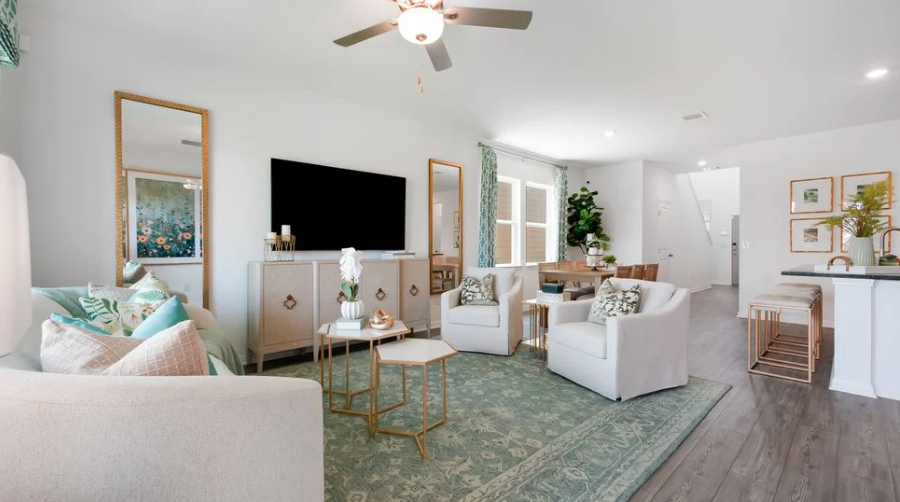
Positioned as a "transitional residential hub" between urban infrastructure and suburban sanctuary, Village Grove challenges the local status quo. By looking deeper into the strategic master plan of this development, we can see how market mechanics are shifting to favor density, shared amenities, and infrastructure-first planning (which is uncommon in area as for a long time many people touted the slogan “if you don’t build it, they won’t come.”. Here are five surprising takeaways that give us a peek into the likely future of the Hill Country.
1. The "Accessible" Entry Point to a Luxury Market
Dripping Springs is notorious for its high barrier to entry, with a median home price hovering around $865,000 / $309 per square foot. For young professionals and rightsizers, the "Gateway to the Hill Country" has often felt like a gated community. Village Grove disrupts this by leveraging higher residential densities to drive down the cost-per-unit while providing what many consider to be a more comfortable lifestyle.
The developer, Taylor Morrison, utilizes what they call a streamlined, energy-efficient building process to offer a total inventory of 428 units (248 townhomes and 180 single-family homes) at a strategic price position. This inventory allows for price points that were previously non-existent in the Dripping Springs Independent School District (DSISD) and that’s a big deal.
By trading massive private tracts for optimized lot sizes, the development creates a viable pathway for buyers who prioritize the DSISD academic reputation over the maintenance of a five-acre lot. Or the price tag of a 4,000+sq ft home.
2. Surplus Green: Why Developers Over-Delivered on Parkland
While critics often equate density with "concrete jungles," the strategist’s view of Village Grove reveals a "shared space" philosophy that actually exceeds municipal mandates. Under city code, the development’s 511 Living Unit Equivalents (LUEs) required a dedication of 22.22 acres of parkland. The developers provided 30.91 total acres of parkland credit, an 8.69-acre surplus - and this is adjacent to Down Town DRIP! Walking to HEB from this community is certainly doable for many.
The plan distinguishes between public and private dedications to maximize community utility. It includes 16.27 acres of public open space, 4.94 acres of amenity ponds, and "The Grove," a 1.00-acre civic park designed for markets and community events. A strategic win for the development is its physical adjacency to the 19.64-acre Dripping Springs Sports and Recreation Park.
"This connection gives residents direct access to public sports fields, basketball courts, and playgrounds, reducing the need for redundant private infrastructure and keeping HOA fees at a stable $100 per month."
3. The Parkway First: A Rare Win for Infrastructure Timing
In most Texas developments, infrastructure is reactive; residents move in and wait years for road expansions to catch up with traffic. Village Grove inverted this through a public-private roadway agreement that prioritized the Village Grove Parkway. Completed in November 2025, the parkway opened concurrently with the first home occupancies and it’s a roadway that I, coming from Driftwood, use regularly when heading out to Founders Ridge of DSISD Elementary.
This $2.3 million capital expenditure is more than just a road; it is a sophisticated traffic-management play. The developer installed a new signalized intersection at Ranch Road 12, which specifically replaced the outdated signal at Sports Park Road to streamline regional flow.
From a strategist’s perspective and even that of many Dripping Springs residents, the funding model is the most interesting detail: while the developer funded the initial $2.3M, they are being reimbursed approximately $716,900 through "municipal reuse fee rebates" (calculated at $1,675 per lot). This "infrastructure-first" approach provides immediate value, ensuring that the development eases rather than exacerbates the 290/RR12 bottleneck.
4. The "Low-Maintenance" Trade-Off: 40-Foot and 50-Foot Lot Living
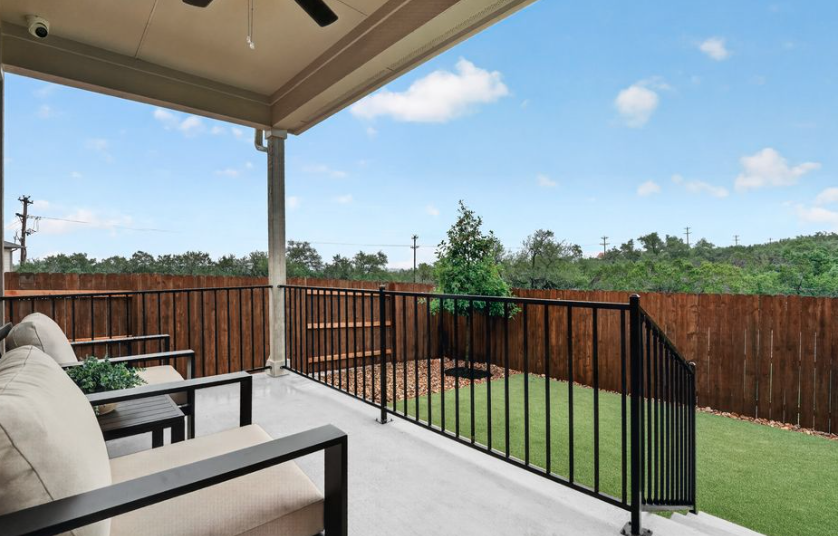
The Village Grove master plan reflects a broader municipal push to move density inside city limits, where per-unit infrastructure and maintenance costs are lower.
The Village Grove master plan reflects a broader municipal push to move density inside city limits, where per-unit infrastructure and maintenance costs are lower. This is achieved through two distinct lot classes:
The 40-Foot Lot Class: These lots utilize compact footprints and smaller setbacks to maximize indoor square footage (1,463–2,366 sq. ft.). To address Central Texas's water challenges, these homes emphasize "zeroscaping" and various turf options, appealing to the buyer who wants a premium interior without the burden of a high-maintenance and high-cost of a yard and traditional landscaping
The 50-Foot Lot Class: Offering a more traditional feel, these 50' x 120' lots (approx. 0.14 acres) accommodate larger footprints (up to 3,140 sq. ft.). These plans, like the "Piedmont" or "Balcones," feature front-facing two-car garages and customizable spaces such as multi-generational suites and home offices, targeting growing families.
This transition toward smaller, managed lots is a direct response to the rising costs of land, water, and labor, prioritizing lifestyle connectivity over land ownership.
5. The School Boundary Mirage: Why "Zoned" Doesn’t Mean "Permanent"
For many buyers, the 2025–2026 academic pathway—Dripping Springs Elementary, Middle, and High School—is the primary draw. However, a home buyer looks at the data and sees a "mirage." DSISD has added 4,000 students in a decade, and the district’s 2030 vision requires an expansion to 12 elementary schools, 5 middle schools, and 3 high schools.
While Village Grove currently benefits from its proximity to these core campuses, the "rapid development" of massive nearby subdivisions, specifically Double L Ranch (which will be massive), Wild Ridge, and Cannon Ranch, makes future boundary realignments a statistical certainty. Prospective residents must understand that in a high-growth corridor, your school zone is a snapshot in time, not a permanent guarantee; I can’t stress this enough but know that all D.S.I.S.D schools are great! Get more information on the budget and zoning of Dripping Springs schools here.
So, will this neighborhood model catch on?
Village Grove represents a distinct departure from the "sprawl at all costs" mentality of traditional Texas development. By front-loading infrastructure, exceeding parkland requirements through shared space, and offering a tiered density model, it provides a blueprint for how the Hill Country can grow without losing its soul to traffic and high entry barriers.
As the Austin suburbs continue to expand, the success of Village Grove will likely determine if this
Explore the Dripping Springs & Driftwood Neighborhood Guide.model of density and shared amenities becomes the regional standard, personally I think there is a good change we’ll see more communities like this here and in Hays County ISD.