
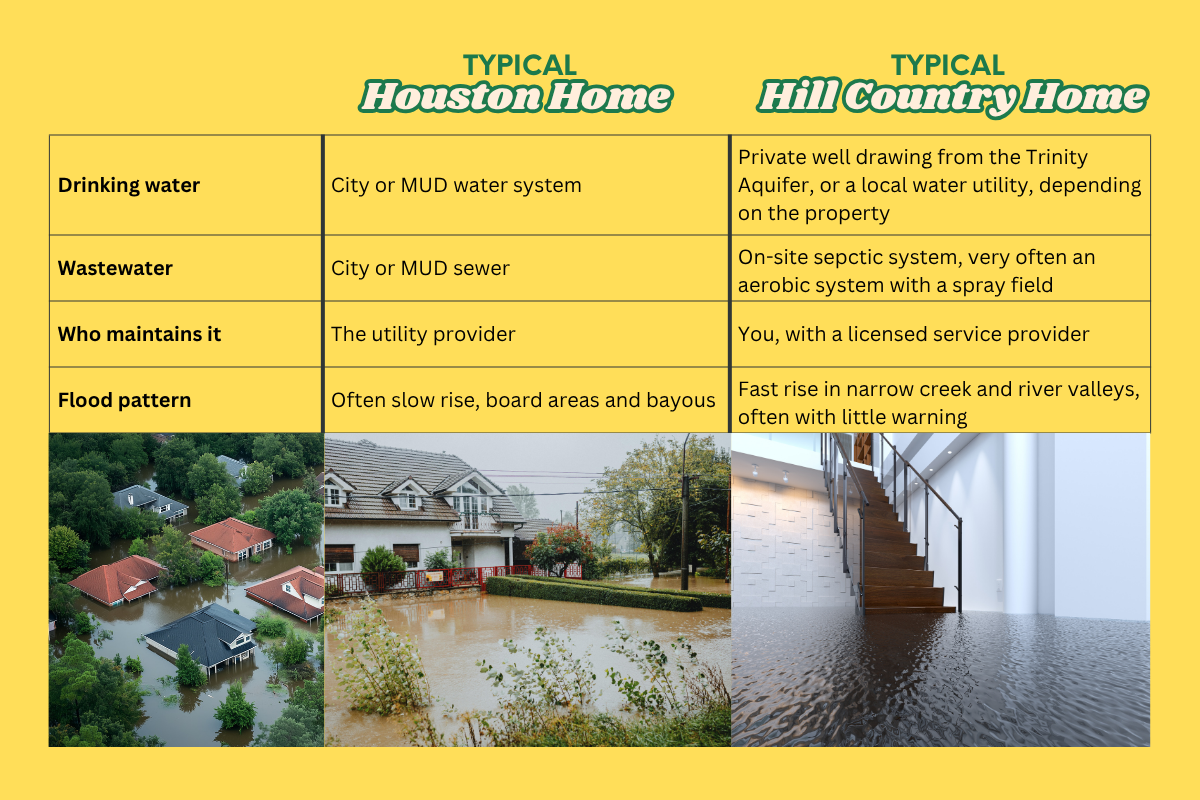
If you're moving from Houston to the Texas Hill Country, you already know more about flooding than most buyers in Texas. You likely know what a Zone AE is. You know to ask whether a house took on water during Harvey. You may have carried flood insurance for years.
That experience is an advantage in Dripping Springs and Driftwood. But it can also give you a false sense of security, because nearly everything about how water works here is different: where your drinking water comes from, where your wastewater goes, and how, when, and where flooding actually happens and it does happen.
Private Water Wells
Who regulates wells here
Western Hays County, including Dripping Springs, Driftwood, Henly, and Wimberley, falls under the Hays Trinity Groundwater Conservation District (HTGCD), which manages groundwater from the Trinity Aquifer. Eastern Hays County falls under a neighboring district, the Barton Springs Edwards Aquifer Conservation District.
Wells used for household or agricultural purposes are classified as exempt wells. Under HTGCD rules, they still have to be registered with the district before they're drilled, but they don't need an operating permit the way larger commercial or utility wells do. Thousands of wells in western Hays County were drilled before the district existed in 2001, so it's worth asking whether the well on a property you're considering is registered.
Why drought matters to your purchase
This is the part Houston buyers rarely think about. The Trinity Aquifer is heavily influenced by rainfall, and when it's dry, water levels drop.Water here is a finite, shared resource, and a well's performance today is not a guarantee of its performance in a dry summer and that is really something to consider. Is there the option for public water to be hooked up? Will you harvest rain water?
What to check on a well
The well record. Ask the seller for the driller's report, which typically shows the well's depth, construction, and the water level when it was drilled. A deeper, properly constructed well generally gives you more margin during drought.
Registration with HTGCD. Confirm the well is registered with the district, or ask how the seller handled registration if it's an older, pre-district well.
Water quality testing. The Texas Well Owner Network, run through Texas A&M AgriLife, recommends testing private wells at least once a year for bacteria, nitrates, and any contaminants of local concern. For a purchase, test during your option period, not after closing.
A well and pump inspection. A standard home inspection usually doesn't evaluate the well itself. Hire a licensed well or pump professional to look at the pump, pressure tank, wellhead, and flow.
Distance from the septic system. For new wells, HTGCD requires spacing of 50 feet from a septic tank, 100 feet from a sanitary (disposal) field, 150 feet from other sources of contamination, and 50 feet from the property line. Older wells may predate these standards, which is one more reason water testing matters.
Your plans for the land. If you're dreaming of a big lawn, a pool, or livestock, talk through your expected water use with your inspector and with HTGCD before you commit.
Septic Systems (and Why "Aerobic" Changes Everything)
How septic is regulated in Hays County
In unincorporated Hays County, every on-site sewage facility, or OSSF, requires a permit from Hays County Development Services, regardless of the size of the lot. My personal home in Driftwood has this permit and the annual service contract (that isn’t cheap) along with it. The county's authority comes from Chapter 366 of the Texas Health and Safety Code, and the technical rules follow TCEQ's regulations in Title 30, Chapter 285 of the Texas Administrative Code. Bedtime reading maybe?
Conventional vs. aerobic systems
A conventional septic system uses a tank and a buried drain field. Thin soil and shallow limestone are common in this part of the Hill Country, so many properties instead use an aerobic treatment unit (ATU), which treats wastewater with oxygen and disinfection before spraying the treated effluent onto a designated area of the yard (the spray field). You'll often spot the sprinkler heads and a small lid or control panel in the yard during a showing.
Aerobic systems work well, but they come with ongoing obligations that Houston buyers on city sewer have never had to think about:
A maintenance contract is required. Hays County requires ongoing maintenance for all aerobic and advanced treatment systems, including drip irrigation systems, with a licensed maintenance provider.
Regular inspections are built in. Under TCEQ rules, the maintenance provider must submit a report to the permitting authority and the owner at least once every four months. That can drop to every six months if the system has qualifying electronic monitoring.
The obligation follows the property. When an aerobic system is permitted, an affidavit is filed in the Hays County deed records noting the maintenance requirement. It becomes your responsibility the day you close.
Chlorine is part of the routine. Many aerobic systems use chlorine tablets for disinfection, which the owner or provider keeps stocked.
TCEQ allows some homeowners to take over maintenance of their own aerobic system after the first two years with the right training, but it also notes that local permitting authorities can adopt stricter rules. Check with Hays County Development Services before assuming you can self-maintain.
If you are planning on putting in a pool, it’s vital to understand the required setbacks from the spray field, A yard that looks plenty large enough for a pool may not be able to accommodate one currently based on where the septic spray field is: it is possible and typically feasible, although can be expensive, to move the septic system sprayers, etc., to allow for the space that your new pool would need. This is definitely something that you'd want to consider if you are running numbers and including in those numbers the cost to put in a pool or other backyard scape (whether that is basketball courts, tennis courts, a casita, or even a sandbox).
What to check on a septic system
Pull the permit file. Ask for the OSSF permit and approved design. The permit tells you what type of system you have and what size home it was designed to serve.
Match the system to the house. If the home has been expanded, a bedroom added, or a casita built since the system was permitted, ask whether the septic permit was updated to match. This is one of the most common surprises on resale homes.
Get the maintenance history. For aerobic systems, request the current maintenance contract and recent inspection reports.
Order a septic inspection by a qualified OSSF professional during your option period, separate from your general home inspection. Ask them to look at the tank, aerator, pump, alarms, and spray heads.
Walk the spray field. Know where it is, where it can't be built on, and how it affects your plans for a pool, shop, or garden.
Flash Floods in "Flash Flood Alley"
Why Hill Country flooding is different from Houston flooding
Houston floods are usually about rising water spreading across flat neighborhoods. Central Texas floods are about speed and terrain. The Balcones Escarpment and Hill Country form what's widely known as Flash Flood Alley, where heavy rain on thin soil and rock runs off fast into narrow creek and river valleys. A dry creek bed can become dangerous in a matter of minutes.
Our region has lived this. The Memorial Day 2015 flood on the Blanco River in Wimberley and the July 2025 Hill Country floods are part of why local buyers ask about water differently than they did a decade ago. This latter flood hit every close to home and our Rotary Club of Dripping Springs continues aiding in the rebuilding efforts. In the year since the July 2025 floods, Hays County has expanded its flood warning tools, including traffic rerouting around closed low water crossings and a planned real-time flood map using data from the Blanco River and Onion Creek.
The house vs. the road
Here's the key mindset shift for Houston buyers: a home can sit well above the floodplain and still be cut off by water, meaning the house itself is unlikely to flood but you can still be cut off from emergency help and Door Dashers alike.
Hays County has hundreds of low water crossings, and the county's flood warning system now covers more than 30 of them with sensors, rain gauges, and flashing warnings. Some crossings, including FM 150 at Onion Creek, also have monitoring cameras. When a crossing is flagged, it shows as yellow (use caution) or red (closed) on the county's low water crossing map at HaysInformed.com.
Reading the flood disclosure
Texas Property Code Section 5.008 requires sellers to disclose, among other things, whether the property sits wholly or partly in a 100-year floodplain, a 500-year floodplain, or a floodway, whether the structure has taken on water in a natural flood, whether the seller currently carries flood insurance, and whether they've ever filed a flood insurance claim.
You probably know this form well from Houston. The same caution applies here: the disclosure reflects what the seller knows, not a guarantee of risk. Pull the FEMA flood map for the address yourself, and remember that flash-flood risk to a driveway, access road, or low corner of the lot may not show up on the form at all.
Flood insurance: timing matters
Many Houston buyers already carry flood insurance, and there's a good case for keeping it even on homes outside a mapped floodplain here. One timing detail matters: NFIP flood policies normally have a 30-day waiting period, but that waiting period is waived when the policy is purchased in connection with making a mortgage loan. In plain terms, set up flood coverage at or before closing rather than after you move in. Homebuyers, very often first time buyers, ask if they should get flood insurance even if the property is not within a flood plain. My answer is, yes. Without a doubt, yes. If the home isn’t in a flood plain the premium will be fairly low and frankly, weather has only been getting more and more remarkable for the last decade plus. Note: flood insurance isn’t purchased the same way homeowners insurance is, flood insurance must be purchased through F.E.M.A., it will be it’s own policy that many times you can purchase with the carrier of your homeowners insurance but unlike your homeowners insurance your flood policy is backed by the Federal Government.
Your Due-Diligence Checklist for Wells, Septic, and Flood
Be ready to use your option period to work through this list (pro tip: contact inspectors now, even schedule their services prior to going under contract if the wait time to get on their schedule is concerning (you can always cancel the appointment if needed) on any Dripping Springs or Driftwood home that isn't on public water and sewer:
Confirm whether the home is on a private well or a water utility, and whether it's on septic or a central wastewater system
Request the well driller's report and confirm HTGCD registration
Order a well water quality test (bacteria and nitrates at minimum)
Hire a well or pump professional to inspect the well system
Request the OSSF permit, approved design, and (for aerobic systems) the maintenance contract and recent reports
Confirm the septic permit matches the current number of bedrooms and structures
Schedule a separate septic inspection with a qualified OSSF professional
Locate the spray field or drain field and confirm it works with your plans for the property
Review the seller's flood disclosure and pull the FEMA flood map for the address
Check HaysInformed.com's low water crossing map for your daily routes
Get a flood insurance quote and bind coverage at or before closing
Moving from Houston and want a Hill Country home that checks out above ground and below it? Let's find it! Schedule a Conversation