
Your First Property Tax Bill in Dripping Springs or Driftwood: What Out-of-State Buyers Need to Know
If you're moving here from California, you already know Proposition 13 by heart. Texas has one now too. Voters passed it in November 2025, and it does something completely different from California's. California's Prop 13 caps how fast your assessed value can grow. Texas's Prop 13 raised the homestead exemption for school district taxes from $100,000 to $140,000.
The bigger adjustment isn't the exemption amount. It's the calendar. In California, your property tax life starts the day you close: the county reassesses at your purchase price and mails a supplemental bill. In Texas, almost everything keys off a single date, January 1. Who owns the home, what it's worth, and which exemptions apply are all locked in as of that morning, and they stay locked for the whole year.
That one rule explains nearly every surprise California buyers run into with their first Hays County bill. Here's how it looks from a buyer's perspective.
Your First Bill: Whose Name, How Much, and Who Pays
The bill for the year you closed covers the entire year, and it's yours to pay. The Hays County Tax Office does not prorate taxes. The bill has to be paid in full. The split between you (the buyer) and the seller happened at closing: the standard TREC resale contract prorates the year's taxes through the closing date, so the seller credited you for their months. Now the full bill comes to you. Your agent should review this with you when your settlement statement is received a few days prior to closing.
It may not have your name on it. Ownership records can lag behind a recent sale, and if your lender requested the statement, it goes to the lender instead of to you. If your taxes are escrowed, your lender pays from that account. If they aren't, you're paying directly.
Not receiving a bill doesn't change the deadline. Taxes are due on receipt and must be paid no later than January 31. If you haven't seen a statement by mid-December, the county asks you to contact the Tax Office so they can send another one. I truly cannot stress this enough for relocating buyers: a bill that went to the seller's old address or to the wrong lender is still your bill, and February 1 penalties still apply.
The estimate at closing may not match. Closing prorations are usually based on the prior year's taxes, because the current year's rates aren't set yet. The TREC contract lets buyer and seller adjust the proration once the actual statement comes out. If your real bill comes in noticeably different from what was estimated at closing, ask your title company about that adjustment.
The Hays County Property Tax Year at a Glance
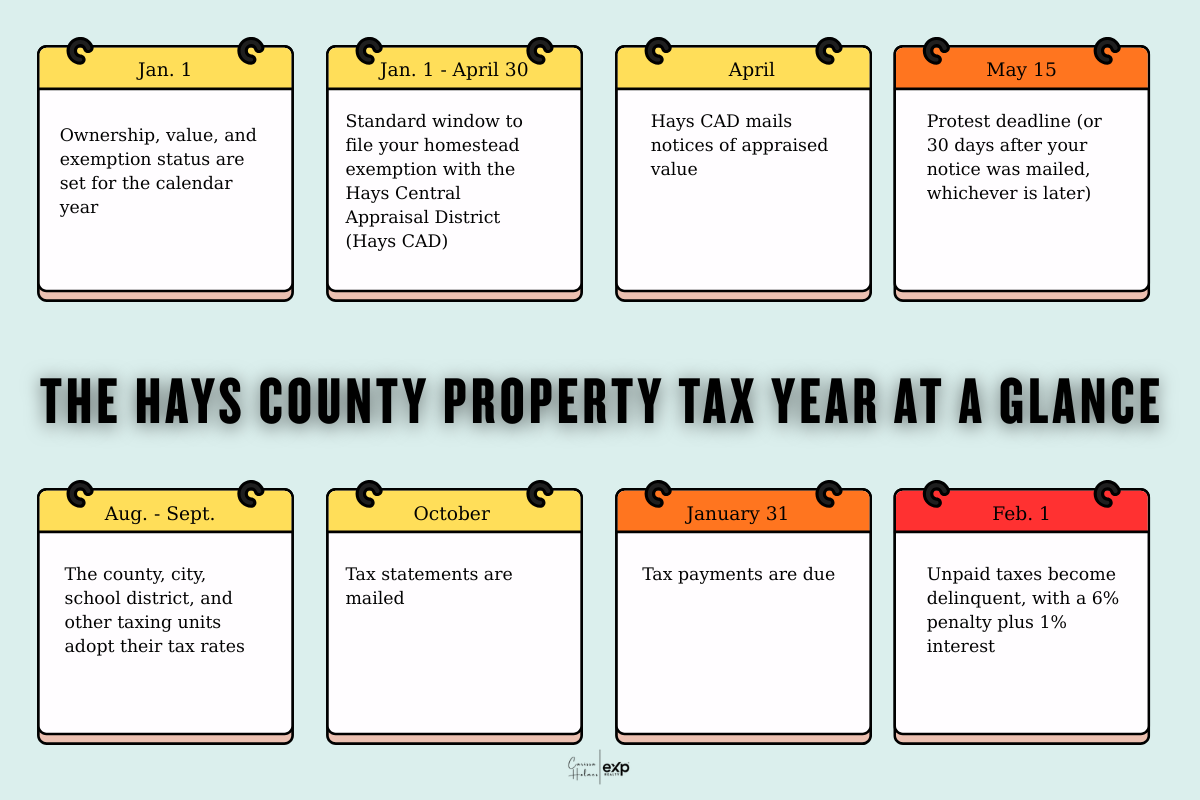
The 8 dates all Texas property owners should know.
Important note in October, The Hays County Tax Office can mail statements as early as October 1, but the date can move. In 2025, the office held statements until mid-to-late November because the constitutional amendments on the November 4 ballot would change what everyone owed. Waiting meant homeowners got one correct bill instead of a bill and a refund. The January 31 deadline didn't move. This may occur again this year.
The January 1 Rule, and the Exception Worth Real Money
Hays County sets exemption status as of January 1. If the seller had a homestead exemption on January 1 of the year you bought, that exemption stays on the account for the rest of the year. Your first bill is calculated on the seller's exemption. You can't add your own for that year, and you don't need to.
What you do need to do is file for next year. If you closed on a resale home in 2026, the bill arriving this fall covers 2026, and it's already using the seller's exemption. Your own homestead application is for 2027, filed between January 1 and April 30, 2027. Skip that filing and your 2027 bill will be calculated with no homestead exemption at all and holy moly that that amount may shock you.
The exception: homes with no exemption on January 1
If the home did not have a homestead exemption on January 1 of the year you bought it, the timing flips. Since 2022, Texas law (Tax Code Section 11.42(f)) lets you apply as soon as you own the home and live in it, and you receive a prorated exemption for the rest of that year. Again, your agent should be able to explain this to you in detail.
That covers a lot of Dripping Springs purchases:
New construction, including homes in Caliterra, Headwaters, and Village Grove bought from a builder
Spec homes that were owned by a builder or developer
Former rentals or second homes, where the previous owner lived somewhere else
If you're in one of those situations, don't wait for January. File with Hays CAD after your deed records and your Texas driver's license shows the new address.
Be aware that some official county FAQ pages still describe the pre-2022 rule, telling new owners to file for the next January 1. That's still correct for most resale purchases. It's not correct for a home that had no homestead exemption when the year started. Make note of this to ask your Title company.
How to tell which situation you're in: look up the property on hayscad.com and check which exemptions are listed for the current year, or ask your agent to pull it before closing. Knowing the answer before you close also tells you what your first bill will look like.
While I am not a licensed tax professional, I would be happy to refer a few for you to reach out to, just request “tax professionals” on the this form.