
Online estimate vs. reality: There’s a critical difference in the majority of cases
If you're a homeowner in Texas, you've likely glanced at one of the popular real estate websites, you know the ones, and plugged in your address to see the magic number: your home's “estimated value”. It’s fast, free, and instantly gratifying and sometimes terrifying
I need to address a crucial reality, especially in our market: Online home value estimates are not appraisals, and they are not your home's true market value. They can get somewhat close particularly in states where the price a property sells for is public information - that’s not the case in Hays County Texas.
The difference between these automated figures (often called AVMs, or Automated Valuation Models) and the price a qualified buyer will actually pay is significant, and that gap is made even wider by a key factor unique to our state.
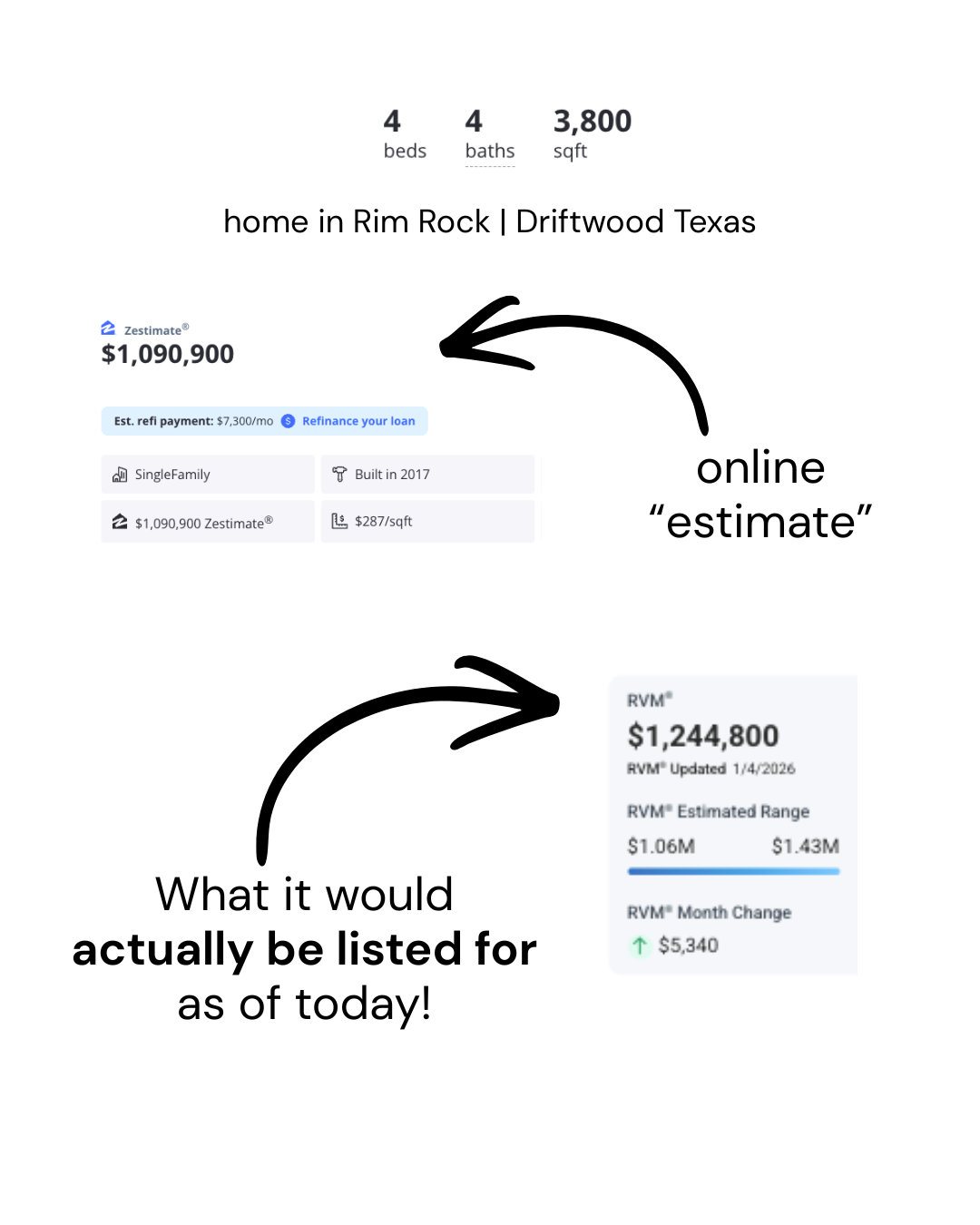
online estimate vs. what a home in Driftwood Texas would actually be listed for if it were to go on the market today
How the Automated Systems Arrive at Their Number
Online valuation models pull data from public records and algorithms. This is what they can access:
Public Data: Square footage, number of bedrooms/bathrooms, lot size, and property tax history.
Listing Data: The initial asking price of recently listed homes in your neighborhood.
Generic Market Trends: Broad economic and interest rate data for the metro area.
What they cannot accurately assess is everything else that drives your home’s value and because of the next reason (below), the ranges these algorithms work within is vast.
A handful of states are different than the rest: Texas is a Non-Disclosure State
This is the most critical piece of information for any Texas homeowner relying on an online estimate. Even if you’re just having “maybe we could…” conversations with your partner, what if that AVM is 10%, 15% or even 25% off? 4 or 5 times a year I meet with homeowners who are truly BLINDSIDED by their homes actual market value.
Texas is a non-disclosure state. This means that when a home closes, the final sale price is not required to be publicly reported or recorded in government records. Unlike states where the closing price is widely available, here, the information remains confidential.
Why This Matters to Your Online Estimate:
Guesswork for Algorithms: Since the public databases used by the usual suspects of real estate sites often cannot access the actual sold price of your neighbor’s home, their algorithms must rely on less reliable data, such as:
The home’s tax appraised value (which is for tax purposes, not market value) and don’t forget that many homeowners claim their Homestead exemption - are these sites accounting for this?
The property’s initial listing price, which may be significantly different from the final sale price and absolutely does not take into account concessions made by the seller nor the agent's compensation.
Lagging Data: Public tax data is often updated long after the sale closes, meaning the AVMs are constantly working with outdated figures and estimated data, not real-time transactional facts and even though currently sales volume in Driftwood and Dripping Springs isn’t flying off the shelves I, see a visible lag in information on most real estate sites.
So, online estimates in Texas are based on estimates of estimates, whereas in a full-disclosure state, they have access to the actual sold price, which significantly improves their accuracy.
The True Measure: The Comparative Market Analysis (CMA)
If you are serious about knowing your home’s value for a refinance, equity loan, or (most importantly) a sale, you need a professional, data-backed opinion.
A professional Comparative Market Analysis (CMA) done by a licensed Realtor(r) is the gold standard for determining current market value. This is a personalized report prepared by a professional who has access to the comprehensive, up-to-the-minute, confidential data found exclusively within the Multiple Listing Service (MLS).
In my opinion, many CMAs are done for marketing purposes and on a zip code level, not the specific neighborhood. There are dozens of subdivisions/neighborhoods with the 78620 and 78619 zip codes, some currently sit firmly in a Seller’s market while others have shifted into a Buyers market over the last several months.
If you’d like a true CMA of your property, I would be happy to provide it. Just let me know, I’m thrilled to be a resource and no commitment needed, just a conversation!
Thinking of selling or just curious about your home's true value? Let’s talk, it’s never too early in your real estate journey for a conversation.