
Q1 2026 Market Update: Driftwood Texas
What Q1 2026 Is Really Illustrating About the Driftwood Market
If you’ve been trying to make sense of the real estate market so far this year, you’re not alone. Q1 of 2026 didn’t deliver a dramatic headline shift, like many were expecting, it delivered something more important: clarity. And when you zoom in on neighborhoods like Rim Rock, Belterra, Caliterra, and the surrounding Driftwood communities, a pattern starts to emerge.
The easiest way to describe it is this: the market didn’t slow down, it split.
In Rim Rock, for example, we saw inventory quietly build over the course of the quarter, moving from just 2 active homes in January to 6 by March. That’s not a flood of listings by any means, but it’s enough to change buyer behavior. When buyers have options, even just a few more, they start comparing more carefully. That’s where we begin to see the separation between homes that sell and homes that sit.
And that separation showed up clearly in the days on market. Earlier in the quarter, homes were still moving in a relatively normal window, roughly 45 to 50 days. But by March, that number stretched all the way out to 162 days. That’s not a small shift. That’s a signal with a cautionary tale.
At the same time, pricing told its own story. In February, the average sold price in Rim Rock was around $909,000, but by March it had adjusted down closer to $828,000. That doesn’t necessarily mean values are dropping across the board, it means the mix of what’s selling is changing, and more importantly, that buyers are pushing back when homes aren’t positioned correctly.
You can see that negotiation dynamic in the list-to-sale price ratio as well. Earlier in the quarter, homes were still closing right at or near 100% of list price. By March, that had shifted closer to 92%. That gap is where strategy lives now.
And this isn’t just a Rim Rock story.
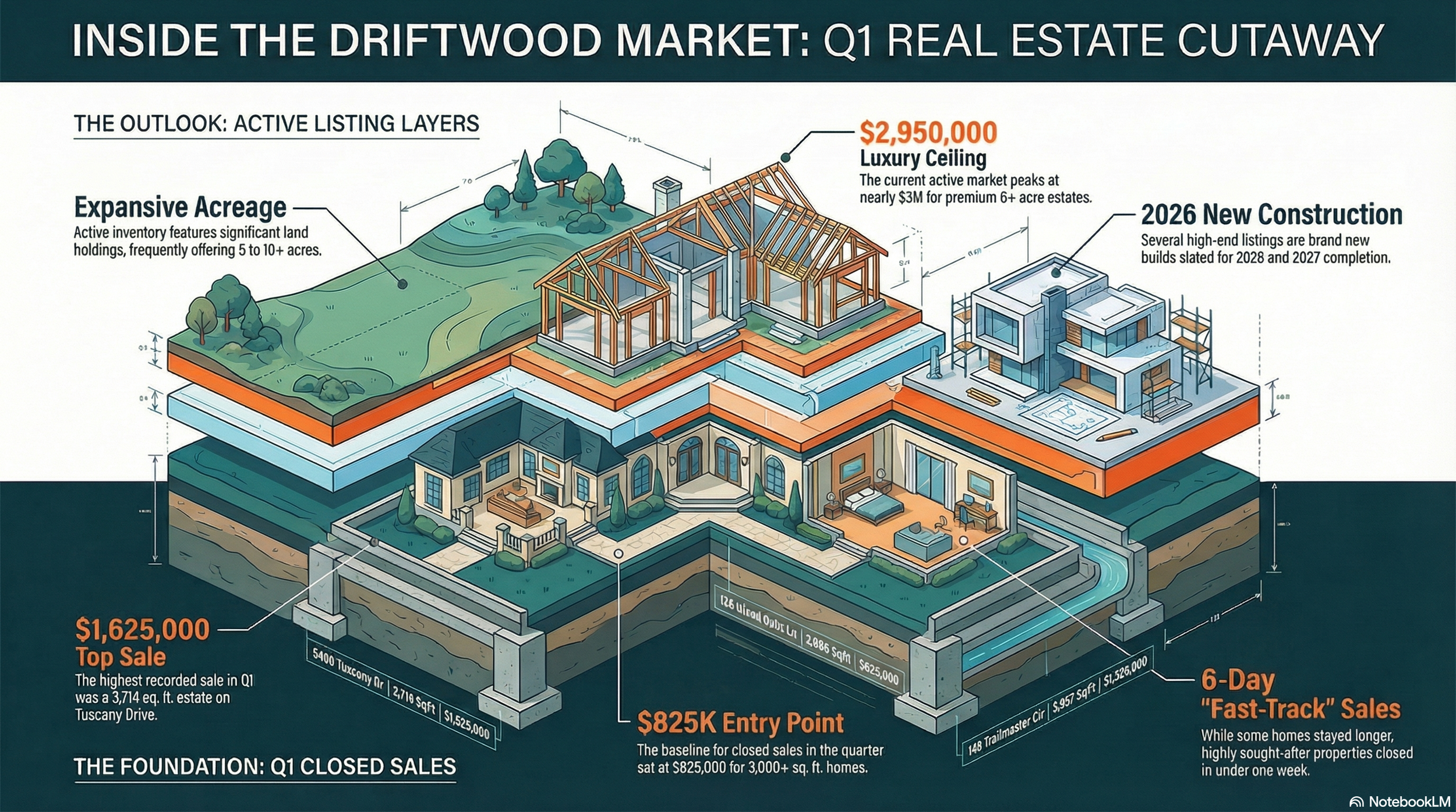
Across Driftwood and Dripping Springs communities, there’s a consistent theme emerging. In higher-end segments, we’re still seeing strong ceilings, active listings pushing toward the $2.9M range, particularly for larger acreage properties or newer construction. At the same time, the entry point for many neighborhoods is clustering around the low $800s, especially for homes in that 3,000+ square foot range.
What’s interesting is not just the range, it’s how differently homes behave within it.
Some properties are still going under contract in under a week or two. Those are typically the ones that hit the market dialed in: priced correctly, presented well, aggressively marketed and aligned with what buyers are actually looking for right now. Others, often just slightly off in price or condition, are lingering for months.
That’s the defining characteristic of this market: it’s no longer forgiving.
In previous years, you could get away with testing the market. You could price a bit high, wait, and still expect strong activity. Q1 2026 is showing us that those days are behind us, at least for now. Buyers are engaged, but they’re selective. They’re watching, comparing, and acting quickly when something stands out.
Which brings us to the bigger takeaway.
The “average” numbers, average price, average days on market, are becoming less useful on their own. They flatten out what is actually a very layered market. Two homes in the same neighborhood can have completely different outcomes depending on how they’re positioned.
That’s why looking at neighborhood-specific data matters more than ever right now.
Because the question isn’t just “what is the market doing?” it’s “where does your home fit inside of it?”
And that answer is much more nuanced than it used to be.
If you want to dig into the specifics for your neighborhood, whether that’s Rim Rock, Belterra, Caliterra, or another Driftwood community, I’ve put together detailed breakdowns for many of the communities in our area so you can see exactly how things are trending locally. You can check them out here.